
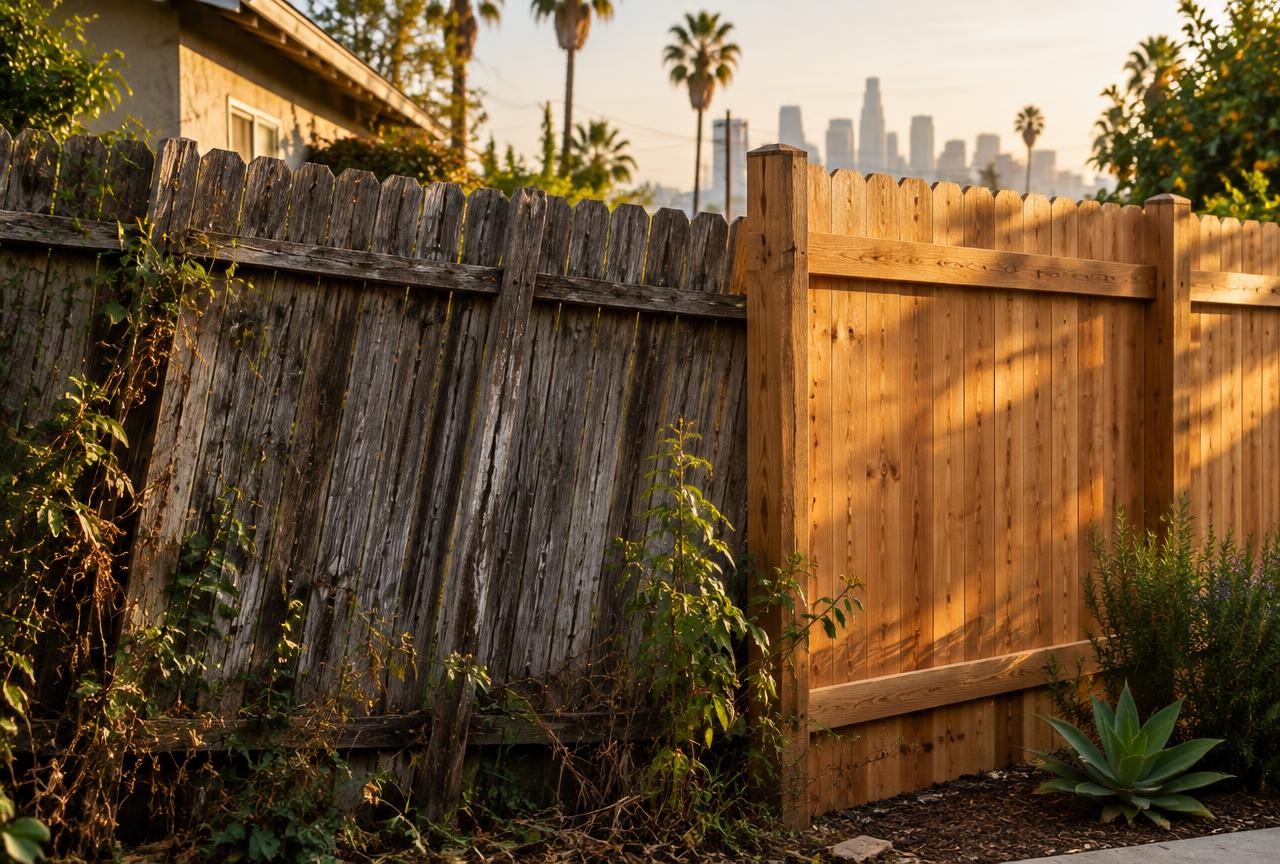
A damaged fence doesn’t always mean you need an entirely new fence — here’s how to tell whether a repair or a replacement makes more sense.
A damaged fence doesn’t always mean you need an entirely new fence. Sometimes a few damaged boards, a leaning post, or a broken gate can be repaired quickly and affordably. In other situations, repairing one problem after another is only delaying the inevitable, and replacing the fence is the smarter long-term decision. So how do you know which option is right for your property? Should you repair your existing fence, or is it time to replace it? At Fence Guys, we believe homeowners should understand the condition of their fence before spending money on a project. A professional evaluation can help identify whether the existing structure still has enough life left to justify repairs or whether replacement makes more sense. This guide will walk you through the biggest signs to look for and help you understand the difference between a simple fence repair and a complete fence replacement.
The First Question: How Bad Is the Damage?
The most important factor is the overall condition of the fence.
A fence with one or two damaged boards is very different from a fence with widespread rot, failing posts, structural movement, and multiple damaged sections.
Before deciding what to do, take a step back and look at the fence as a whole.
Ask yourself:
* Is most of the fence still strong? * Are the posts stable? * Are only a few boards damaged? * Is the fence leaning? * Are sections separating? * Is there significant rot? * Are the gates still functioning properly? * Has the fence been repaired multiple times? * Is the fence still providing the privacy or security you need?
The answers can tell you a lot about whether repair or replacement is the better option.
When Fence Repair Makes Sense
Fence repair is often the right choice when the majority of the fence is still structurally sound and the damage is limited to specific areas.
For example, you may not need to replace an entire fence simply because a few boards have been damaged.
Common repair situations include:
Broken or Damaged Boards
Wood fence boards can become cracked, broken, warped, or damaged over time.
If the surrounding fence is still in good condition, replacing individual boards may be enough.
A Damaged Fence Post
A single damaged or unstable post doesn’t necessarily mean the entire fence needs to be replaced.
Depending on the situation, the post may be repairable or replaceable while keeping the rest of the fence intact.
Minor Sections of Damage
If only one portion of the fence has been damaged, replacing that section may be more practical than removing the entire fence.
Gate Problems
A fence may be structurally sound while the gate has become damaged, sagged, or difficult to operate.
In some cases, the gate, hinges, latch, or supporting components can be repaired or replaced without replacing the entire fence.
Signs Your Fence May Need Repair
A fence may be a good candidate for repair if:
* Damage is limited to a small area * Most boards remain in good condition * Posts are stable * The fence is generally straight * There is little or no widespread rot * The fence still provides the privacy you want * The fence still meets your security needs * Problems have not been occurring repeatedly * The overall structure remains strong
In these situations, a targeted repair can potentially extend the useful life of the fence without the cost and disruption of a full replacement.
When Fence Replacement Makes More Sense
Sometimes repairing a fence is simply putting a temporary solution on a much larger problem.
If the fence has widespread structural damage, replacing it may ultimately be the better investment.
Here are some of the biggest warning signs.
1. Widespread Rot
Rot is one of the biggest concerns with older wood fencing.
A small amount of deterioration may be manageable.
But when rot has spread across multiple boards, posts, or sections, continuing to replace individual pieces may not make financial or structural sense.
The problem can also be deeper than what you can see from the outside.
A fence may look acceptable at first glance while important structural components underneath or near the ground have deteriorated.
2. Multiple Leaning Sections
One leaning section could be caused by a single failed post.
But if several sections of the fence are leaning, shifting, or pulling away from their original alignment, it may indicate a larger structural problem.
A fence that is consistently leaning may have issues involving:
* Posts * Footings * Soil conditions * Age * Water exposure * Structural movement * Previous installation problems
If the problem affects a large portion of the fence, replacement may be more practical than repeatedly repairing individual sections.
3. The Posts Are Failing
Fence posts are critical to the stability of the entire structure.
The posts hold the fence upright and transfer the forces placed on the fence into the ground.
If several posts are damaged, loose, rotted, or failing, replacing boards alone won’t solve the underlying problem.
This is one of the most important things to consider when deciding between repair and replacement.
A fence can have beautiful new boards and still be structurally weak if the supporting posts are failing.
4. You’re Constantly Repairing the Same Fence
If you’re repairing your fence every few months or repeatedly fixing different sections, it’s worth asking whether you’re spending money on a fence that has reached the end of its useful life.
Individual repairs can make sense.
But repeated repairs can add up.
Eventually, you may reach a point where investing in a new fence provides more value than continuing to repair an aging one.
5. The Fence No Longer Meets Your Needs
Sometimes the problem isn’t damage.
Sometimes the fence simply doesn’t work for your property anymore.
Maybe your old fence doesn’t provide enough privacy.
Maybe your family needs a more secure backyard.
Maybe you’ve added landscaping or remodeled your home.
Maybe you want a different style.
Maybe your existing gate isn’t wide enough.
A fence can be structurally fine and still be the wrong fence for your current needs.
In that situation, replacement may make more sense than repairing an outdated design.
6. The Fence Is Extremely Old
Age alone doesn’t automatically mean a fence needs to be replaced.
A well-maintained fence can sometimes continue serving a property for many years.
However, older fences tend to experience more wear over time.
As a fence ages, consider:
* Structural condition * Previous repairs * Material deterioration * Post condition * Gate condition * Maintenance history * Overall appearance
If the fence is old and experiencing problems throughout the structure, replacement may be worth considering.
Repair vs. Replacement: A Simple Comparison
Situation — Repair: Repair · Replacement: Replacement
A few broken boards — Repair: Usually makes sense · Replacement: Usually unnecessary
One damaged section — Repair: Often makes sense · Replacement: Depends on condition
One damaged gate — Repair: Often makes sense · Replacement: Usually unnecessary
Several leaning sections — Repair: May not be enough · Replacement: Often worth considering
Widespread rot — Repair: Limited repairs may help · Replacement: Often the better option
Multiple failing posts — Repair: May become costly · Replacement: Often worth considering
Repeated repairs — Repair: May become inefficient · Replacement: Often makes more sense
Fence no longer meets your needs — Repair: Limited benefit · Replacement: Strong option
Major structural deterioration — Repair: Usually temporary · Replacement: Usually the better long-term solution
The key is to evaluate the entire fence, not just the most obvious damaged area.
Don’t Let Appearance Fool You
One of the biggest mistakes homeowners make is judging a fence entirely by its appearance.
A fence can look okay from the street while having serious structural issues.
For example, a fence might have:
* Fresh-looking boards * A nice stain * A clean appearance
But underneath, posts could be deteriorating or unstable.
On the other hand, a fence might look older but still have a solid underlying structure and only need some targeted repairs.
That’s why a proper evaluation should look beyond the surface.
What About Wood Fence Repair?
Wood fences are particularly repairable when the damage is isolated.
Individual components can sometimes be replaced without disturbing the entire fence.
Depending on the condition, repairs may involve:
* Replacing individual boards * Replacing damaged posts * Repairing sections * Fixing gates * Replacing hardware * Addressing loose components * Cleaning and refinishing certain areas
The important question is whether the remaining structure is still worth preserving.
If most of the fence is healthy, repairing the damaged areas can be a smart choice.
If damage is widespread, replacement should be considered.
What About Chain Link Fence Repair?
Chain link fencing can also experience localized damage.
Problems may include:
* Bent sections * Damaged mesh * Loose components * Damaged posts * Gate issues * Hardware problems
A localized problem doesn’t necessarily mean the entire chain link fence needs to be replaced.
However, if the fence has extensive damage or multiple structural components are failing, a larger repair or complete replacement may be appropriate.
What About Vinyl Fence Repair?
Vinyl fencing can sometimes be repaired when individual components are damaged.
However, matching replacement components can be an important consideration.
If the existing fence is older or has experienced significant damage, homeowners may need to consider whether repairing individual sections will create a consistent finished appearance.
In some situations, replacing a larger section—or the entire fence—may create a cleaner result.
What About Iron Fence Repair?
Iron fencing can sometimes be repaired when individual areas are damaged.
Depending on the condition, repairs may involve:
* Damaged sections * Gates * Hardware * Posts * Surface deterioration * Structural components
Because iron fencing is often selected for its appearance as well as security, maintaining the overall design and finish is important.
A professional evaluation can help determine whether localized repairs are appropriate or whether replacement is a better option.
Don’t Forget About Your Fence Gate
Your fence may be in good condition while the gate is not.
Gate problems are extremely common because gates move constantly.
A gate can become:
* Sagging * Misaligned * Difficult to open * Difficult to close * Loose * Damaged * Structurally weak
Sometimes the solution is as simple as repairing or replacing a hinge, latch, post, or other component.
Other times, the gate has reached the point where replacing it makes more sense.
The gate should always be evaluated separately as part of the overall fence inspection.
Is Repair Actually Cheaper?
Usually, repairing a small problem is less expensive than replacing an entire fence.
But homeowners should think beyond the immediate cost.
Imagine spending money on:
Repair → another repair → another repair → another repair
At some point, the total cost of continuing to repair an aging fence may approach the cost of replacing it.
That’s why the best decision isn’t necessarily the option with the lowest price today.
It’s the option that provides the best value for the condition of your property and your long-term plans.
Consider the Age of the Fence
Age is an important part of the equation.
Ask:
How old is the fence?
Then ask:
How much life does the fence realistically have left?
A relatively newer fence with one damaged section may be an obvious repair candidate.
An older fence with widespread deterioration may be a better replacement candidate.
Age should never be the only factor, but it can provide important context.
Consider Your Long-Term Plans
Your plans for the property should also influence your decision.
If you’re planning to sell your home, you may want to consider whether the existing fence improves or hurts the property’s appearance.
If you’re staying in the home for many years, you may want to invest in a new fence that better fits your long-term needs.
If you’re remodeling your backyard, replacing the fence at the same time can create a more cohesive overall design.
The best fencing decision is one that fits both your property and your plans.
What Happens During a Professional Fence Evaluation?
A professional fence evaluation should look at more than just the obvious damage.
Important areas to examine include:
Fence Panels
Are boards, panels, or sections damaged?
Posts
Are the posts straight, stable, and structurally sound?
Gates
Do the gates open and close correctly?
Hardware
Are hinges, latches, brackets, and other hardware functioning properly?
Alignment
Is the fence straight and properly aligned?
Ground Conditions
Could soil movement, drainage, erosion, or other conditions be affecting the fence?
Overall Condition
Is the damage isolated or widespread?
These factors help determine whether repair or replacement is the more sensible option.
Sometimes a Partial Replacement Is the Answer
It doesn’t always have to be an all-or-nothing decision.
You may not need to repair one board and you may not need to replace the entire property perimeter either.
Depending on the condition of the fence, a partial replacement may make sense.
For example, if one side of the fence has significant damage while the other sides remain in good condition, replacing the damaged portion may be a practical solution.
The right approach depends on the structure, material, age, and condition of the existing fence.
Think About the Bigger Picture
Your fence is part of your property.
It affects:
* Privacy * Security * Curb appeal * Backyard usability * Pet safety * Property boundaries * Outdoor entertaining * Overall appearance
That’s why a fence decision shouldn’t be based only on whether one board is broken.
Look at what the fence is supposed to accomplish for your property.
If the existing fence still accomplishes those goals and is structurally sound, repair may be the right answer.
If it no longer provides the functionality, appearance, or structural integrity you need, replacement may be the better investment.
How Fence Guys Can Help
At Fence Guys, we understand that homeowners don’t always know whether a damaged fence needs a simple repair or a complete replacement.
And that’s completely normal.
You shouldn’t have to be a fencing expert to make the right decision.
The goal is to evaluate the condition of the fence, understand what is actually wrong, and determine the most practical solution for your property.
That may mean repairing a damaged section.
It may mean replacing several components.
Or it may mean starting fresh with a completely new fence.
The right answer depends on the fence in front of you.
Final Verdict: Repair or Replace?
So, which one do you need?
Repair your fence when:
* Damage is isolated * Most of the fence remains structurally sound * Posts are stable * The fence still meets your needs * Repairs can reasonably extend its useful life
Consider replacing your fence when:
* Damage is widespread * Multiple posts are failing * Rot is extensive * Several sections are leaning * Repairs keep piling up * The fence is significantly deteriorated * The fence no longer provides the privacy or security you need * You want a completely different style or layout
The most important thing is not to assume you need a complete replacement just because something is damaged—and don’t keep repairing a fence that has already reached the end of its useful life.
A professional assessment can help you understand the condition of your fence and make a decision based on the actual needs of your property.
Is Your Fence Ready for a Repair or Replacement?
Is Your Fence Ready for a Repair or Replacement?
Whether you have a few damaged boards, a leaning fence, a broken gate, aging materials, or a fence that simply isn’t working for your property anymore, Fence Guys can help you determine the right direction.
Repair what can be saved. Replace what has reached the end of its life. Build a fence that’s made to work for your property.
Contact Fence Guys today to discuss your fence repair or replacement project and find the solution that’s right for your home.